
There is a moment I will never forget, sitting in my living room in Massachusetts, flipping through the channels. I was 16 years old, and I came across an episode of a show that I loved, but barely understood called Style With Elsa Klensch. It aired on CNN—a thing that seems impossible now, in a day when political channels are filled only with people shouting at each other—and it featured roundups of fashion shows, tours of swank homes, and interviews with the morbidly and globally stylish.
As a teenager who spent most of her time in stovepipe cargo pants and t-shirts, connected to the living room stereo by the umbilical cord of the headphones, listening to the original London cast recording of Aspects of Love, I was both intimidated and riveted. That’s when I saw Karl Lagerfeld for the first time.
He was waving his fan, nudging his soap-bubble sunglasses up his nose, and Elsa was asking about the inspiration for his new collection, which was filled with zippered plaid and pleather, stripes, and frayed knits.
“Well,” he said. “I am inspired by many things this season, but especially a play I saw in New York.”
“What was the play?” asked Elsa, in her strange, semi-English accent.
“Rent,” he said.
To my mind, this is the exact moment when Rent jumped the shark. It was the spring of 1996. Jonathan Larson was dead. Adam Pascal was on the cover of Newsweek. Mark’s sweater was in the Chanel spring collection and cost $4,000.
I saw the show three times in subsequent years, all on the road. I loved it, but left feeling unsatisfied each time. The show was not the problem. Larson’s fervent, beautiful songs still gave me goosebumps. Angel’s death still played like a steamroller, reducing an entire theater of teenagers to sobs. The problem was the acting. No one on that stage could figure out how to escape the shadow of Rent‘s formidable, iconic original cast. Mark’s flailing was a cartoonish copy of Anthony Rapp’s quirky mannerisms. Young actors scowled and half-closed their eyes as Roger.
By this time, the show also had entered the cultural schema to the extent that its costumes and songs had become instantly recognizable, a kind of boilerplate of downtown cool. Of course, any time that happens, it becomes instantly uncool. Neil Patrick Harris didn’t just play Mark on stage—again, there was Anthony Rapp’s staccato delivery, writ large and accompanied by much wiggling of fingers. He then parodied Mark on Saturday Night Live.
In Rent’s last years in New York, I could not bring myself to go to the theater. I could not bear the thought of its returned original cast, too old now for the material, and too far inside their own performances to separate the original, honest intentions from the iconography.
So, how do you rescue that show from itself? How do you reboot the show—the original kernel of what was good and smart—and leave behind the hype? If you’re Michael Greif, the show’s original director, you blow it up and start over.
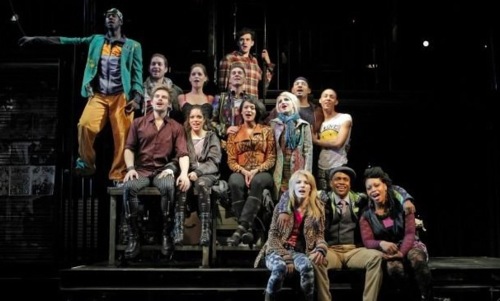
With a new production at New World Stages that opened last night, Greif has attempted to rebuild Rent from the ground up. He has cast younger actors and commissioned a new spate of costumes and sets. Regardless of what the show’s creators have said in the press, though, these things don’t feel or look particularly new. Mimi’s spandex dress in the show’s second act is the exact same spandex dress that Mimi wore on Broadway. Roger, played by Matt Shingledecker, is still doing a lot of scowling and working too hard to find the raspiest notes in his range.
There are two things in particular about this show, though, that make the price of a ticket worthwhile, and elevate this production beyond what it is—a cheapie redo of a really popular show. They are Adam Chanler-Berat as Mark, and Annaleigh Ashford as Maureen. Thanks to them, this Rent revival does feel truly new.
They achieve everything they do by cutting straight through the wreckage left by their predecessors, Anthony Rapp and Idina Menzel. Watching this Rent, you will not miss those two. You will not even think of them, in fact.
Chanler-Berat in particular achieves something so magical with his Mark. Looking almost eerily like Jonathan Larson, he finds all of Mark’s self-consciousness and touchy fear, the things that keep him isolated from his emotionally messy friends. His awakening at The Life Cafe in the show’s famous Act I closing, where the young filmmaker lets go enough to dance on a table, feels like an actual moment of transcendence and not just like another degree of a mild anxiety attack.
Ashford, too, finds a whole new way to play Mark’s flighty, gorgeous ex, Maureen. She heads straight for the comedy, and it’s a great choice. For the first time I can remember, Maureen’s performance in the 2nd Street lot is genuinely funny. And the character’s transgressions—her cheating on both Mark and Joanne—seem like the easy result of overconfidence and a distinct lack of self-awareness. You forgive her easily. Because everyone does.
The material, too, has held up well. Larson’s lovely characters – his crew of willfully impoverished East Village vagabonds – still feel vivid and poignant, their struggle pertinent. You don’t have to have the AIDS virus to understand the difficulties of finding connection in a hyper-technological, increasingly disconnected world. Try dating in New York for a couple of weeks. You’ll see that Larson’s message still resonates today.
And while this production of Rent may not be a radical revisioning of the work, it still tells its story well, and with a couple of amazingly strong performances. Karl Lagerfeld may not be rushing to put Rent’s costumes into his collections these days, but that’s probably a good thing. Mark and Roger, I think, would approve.
photo: broadwayobsession.tumblr.com

{ 3 comments… add one }